
Top Benefits of Professional Cleaning Services
Professional cleaning services give homes and workplaces a planned approach to cleanliness, with agreed tasks, suitable methods and someone responsible for completing them. The main benefits are practical: less cleaning on your own to-do list, clearer standards and a service organised around how you use the space. Whether you need domestic cleaning services or support for business premises, the value starts with choosing the right scope—not simply booking more hours.
What are the main benefits of professional cleaning services?
Professional cleaning offers dedicated time, defined responsibilities and a repeatable routine for looking after a property. Instead of relying on whoever notices a dirty floor or overflowing bin, you agree what needs doing, how often and by whom. A well-managed cleaning service also includes suitable training, supervision and communication, which HSE identifies as important to effective cleaning. (hse.gov.uk)
For a household, that might mean handing over bathrooms and floors while keeping everyday tidying yourself. For a business, it could mean arranging commercial cleaning services around opening hours and setting separate schedules for reception areas, washrooms and quieter rooms.
The useful question is not whether professional help sounds convenient. It is which recurring jobs you want taken off your hands, and what an acceptable result should look like.
More time for the work and life that matter
Start by listing the cleaning tasks you currently handle, including preparation, buying supplies and checking overlooked areas. This gives you a realistic brief rather than a vague request to “clean everything”. It also helps you decide which responsibilities to retain.
At home, you might prioritise the jobs that consume your weekend. In a workplace, business cleaning can be planned separately from employees’ normal duties, with clear boundaries around personal desks, shared kitchens and waste.
Do not assume outsourcing removes every responsibility. Someone still needs to communicate access arrangements, flag changes and review the work. Ask a prospective cleaning company who your contact will be and how adjustments are handled, so managing the service does not become another confusing task.
Consistent standards through a clear cleaning plan
An effective cleaning regime needs a management system: identify problem areas, decide what action is needed and check whether it works. Professional support is most useful when that process becomes a practical schedule rather than an informal promise. (hse.gov.uk)
Ask your provider to separate routine tasks from periodic work. Use a checklist such as:
Every agreed visit: specified floors, bins, washrooms and shared surfaces, with exclusions recorded.
Periodic attention: accessible skirting boards, internal glass or other agreed detail work.
Separate quotations: carpet treatment, high-level cleaning or specialist tasks outside the routine scope.
Quality checks: a named contact, a review process and an agreed way to report missed work.
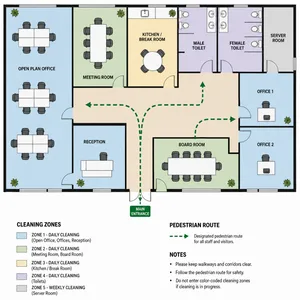
For commercial property cleaning, identify rooms by their actual use rather than applying the same task list everywhere. A rarely used meeting room and a busy entrance need separate consideration when setting priorities.
Suitable methods, not just stronger products
Professional cleaning should involve choosing products and equipment for the task, not automatically using the strongest chemical available. HSE advises using the correct amount of the right product and maintaining cleaning equipment so it remains effective. Ask prospective commercial cleaning companies how they select methods for your floors and other surfaces. (hse.gov.uk)
Tell the provider about delicate finishes, manufacturer care instructions and any products you do not want used. If instructions are unavailable, ask how suitability will be checked before work begins. Avoid accepting a broad promise that one treatment suits every material.
Cleaning chemicals also need appropriate controls. In workplaces, COSHH requires exposure to substances hazardous to health to be prevented or adequately controlled; appointing a contractor is not a reason to ignore these arrangements. Ask about product information, staff instruction and storage responsibilities. (hse.gov.uk)
Better planning around people and premises
Cleaning itself can introduce hazards, including damp floors and trailing equipment cables. HSE recommends preventing access to smooth wet floors through measures such as barriers, locked doors or cleaning in sections. Discuss how a provider will manage occupied areas rather than assuming a warning sign is the entire plan. (hse.gov.uk)

For commercial cleaning in London, build practical access details into the brief. Specify reception procedures, keys, alarms, lift access and any restrictions on deliveries or equipment storage. If several businesses share the building, clarify which areas belong to your contract and which remain the building manager’s responsibility.
The same thinking applies at home. Agree arrangements for pets, occupied rooms and secure access before the first visit, rather than leaving the cleaner to make assumptions.
How do domestic and commercial cleaning differ?
Domestic cleaning focuses on the agreed needs of a home, while commercial cleaning is organised around business premises, their activities and their users. The tasks may overlap, but the access arrangements, reporting expectations and working environment require different briefs. Do not assume that experience in one setting automatically covers every requirement in another.
When comparing cleaning companies for domestic work, explain your household priorities, preferred rooms and any tasks you want excluded. Clarify whether tidying, changing bed linen or cleaning inside appliances is included; do not treat these as automatic extras.
For business premises, ask commercial cleaning companies about supervision, absence cover and communication. A commercial cleaning agency may offer a different staffing arrangement from a directly managed cleaning firm, so establish who employs or engages the cleaners, who checks their work and who resolves problems.
Choosing professional cleaning services in London
Location is a useful starting point, but it is not a complete selection method. Searches such as “commercial cleaning companies near me”, “commercial cleaning service near me” or “business cleaning services near me” can help build a shortlist. Follow that search with questions about coverage, scheduling and your particular premises.
When comparing commercial cleaning services in London, request proposals against the same written brief. Otherwise, one quotation might include supplies and periodic tasks while another covers only routine labour. Ask each cleaning company in London to make those differences explicit.
If you need business cleaning services in London across several addresses, establish how instructions and feedback will be coordinated. For a single property, focus on dependable access and a clear point of contact. The best commercial cleaning services for your situation are those whose proposed scope matches your needs—not simply those making the broadest claims.
How can you tell whether a cleaning service offers value?
Assess value by comparing the agreed work, service arrangements and total quoted cost—not the headline rate alone. A proposal is easier to judge when you can see what is included, what is excluded and how changes will be charged. Ask for clarification before booking rather than relying on assumptions.
Use these questions when reviewing quotations:
What exactly is included? Request a room-by-room or task-based schedule, including visit frequency.
Who supplies equipment and products? Clarify purchasing, storage and any additional charges.
How are missed tasks handled? Establish the reporting route and proposed response process.
What happens when the regular cleaner is unavailable? Ask about cover and notification arrangements.
Which terms affect flexibility? Check cancellation, rescheduling, notice periods and contract length.
What evidence supports the proposal? Request relevant insurance details and references where appropriate.
Be specific about your budget and priorities. If the full wish list is unaffordable, ask for a reduced scope that protects the most important tasks rather than accepting an unclear promise to fit everything in.
Make the first visit a useful starting point
Before work begins, walk through the property or provide clear instructions. Point out priority areas, restricted rooms and anything that needs special care. Confirm whether the first appointment follows the routine schedule or involves separately agreed initial work.
Afterwards, compare the result with the written brief. Give concrete feedback: naming an overlooked shelf is more useful than saying the room “does not feel clean”. Review the arrangement after an agreed period and adjust frequencies or priorities where necessary.
This gives both sides a shared reference point. It also keeps decisions focused on the service you actually need rather than an expanding list of unpriced extras.
Turn the benefits into a clear booking
Professional cleaning is most useful when it replaces uncertainty with a realistic plan. Decide which tasks matter, agree suitable methods and access arrangements, and choose a provider that explains its responsibilities clearly.
Ready to arrange support? Visit the booking page with your property type, location and cleaning priorities to hand. Use those details to establish the right scope before confirming your appointment.
Lucy & Phil Property Solutions
Professional facilities management, commercial cleaning, property maintenance, and construction support across the UK.