
Finding Reliable Private Domestic Cleaners Nearby
Finding dependable help at home starts with more than a search for ‘private domestic cleaners near me’. You need a cleaning arrangement that suits your property, makes responsibilities clear and gives you confidence about who is coming through the door. Lucy And Phil Limited brings residential and commercial cleaning together within a wider property services offering, giving homeowners and organisations a place to discuss their cleaning requirements. (lucyandphilltd.co.uk)
This guide explains how to assess a provider, agree a useful cleaning brief and compare quotations fairly. It also covers regular visits, deeper cleaning and workplace requirements, so you can enquire with a clear idea of what you need rather than simply booking the first available appointment.
How do I choose reliable private domestic cleaners near me?
Choose a cleaner by checking their suitability for your property, the clarity of their quotation, their approach to access and communication, and how they will maintain the agreed standard. Before booking, establish what is included, who supplies equipment, how changes are handled and what happens if a visit cannot go ahead. Treat reliability as a practical arrangement to discuss, not a promise to assume.
Start with your own priorities. You might want dependable kitchen and bathroom maintenance, help keeping on top of floors, or a thorough clean before moving into a property. Each requires a slightly different conversation about time, materials and scope.
A useful initial assessment includes:
Relevant experience: ask whether the provider regularly handles properties and cleaning requirements similar to yours.
Clear identification: establish the business name, your point of contact and who will attend.
Appropriate cover: ask about insurance relevant to the proposed work and any important exclusions.
A written scope: request confirmation of rooms, tasks, frequency and anything specifically excluded.
A communication process: find out how to raise a concern, change instructions or rearrange a visit.
Realistic expectations: look for a provider willing to explain limitations rather than agree to everything without clarification.
Use reviews as one part of your assessment. Look for specific descriptions of communication, attendance and how problems were handled, then compare those themes with the answers you receive directly. Avoid relying entirely on a star rating or a single enthusiastic comment.
Most importantly, notice whether the provider asks useful questions. An enquiry about floor finishes, pets, access restrictions or the condition of bathrooms shows that the discussion is moving beyond a generic price. You should finish the conversation understanding the proposed service, not wondering what ‘a full clean’ actually means.
Domestic cleaning should reflect how your home is used
When comparing domestic cleaning in Sheffield, begin with the rooms and tasks that make the greatest difference to daily life. A household with young children may prioritise kitchen floors and bathrooms. Someone working from home may need appointments organised around calls, while a less frequently occupied property may need a different pattern entirely.
Lucy And Phil Limited lists regular residential cleaning, one-off cleaning and deeper cleaning among its services. Use those categories as a starting point, then discuss the actual condition and requirements of your home rather than assuming every booking follows an identical checklist. (lucyandphilltd.co.uk)
Kitchens and bathrooms need a clear task list
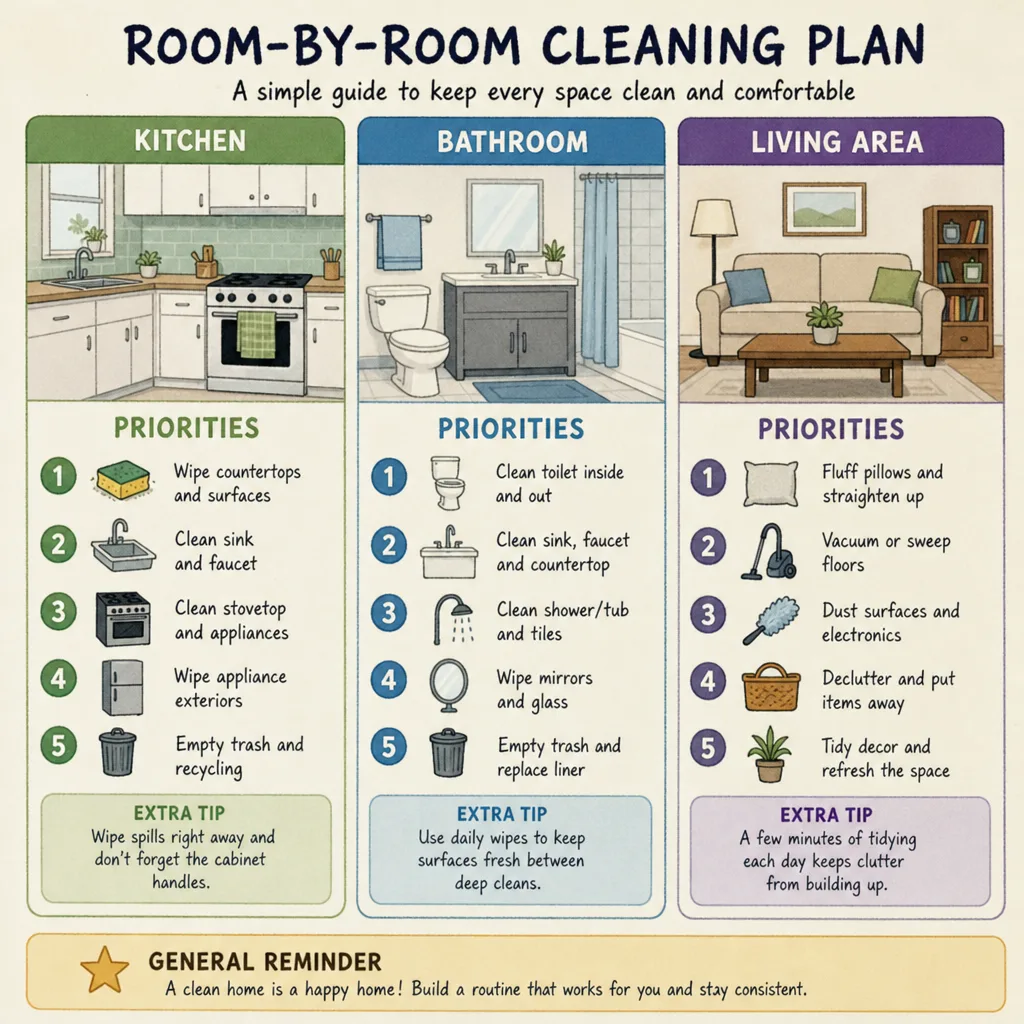
Be specific about kitchen work. Ask whether the proposed service covers accessible worktops, cupboard fronts, splashbacks, sinks, taps, appliance exteriors and floors. If you want the inside of an oven, fridge or cupboard cleaned, identify that separately and agree any preparation required.
For bathrooms, discuss toilets, basins, baths, shower trays, screens, mirrors and accessible fittings. Point out existing staining, damaged sealant or delicate finishes before work begins. Ask the provider to explain what cleaning can reasonably address and what may need another type of attention.
Living spaces and bedrooms need agreed boundaries
For bedrooms, sitting rooms and hallways, define whether you want accessible surface dusting, vacuuming, mopping, bin emptying or bed changing. Decide how ornaments, books and personal belongings should be handled. If an area is not to be touched, make that instruction explicit.
Do not assume that moving heavy furniture, sorting possessions or cleaning inside storage is part of an ordinary visit. Ask first, particularly where furniture is awkward, fragile or connected to electrical equipment. A clear boundary protects both your belongings and the time allocated to the agreed work.
A room-by-room brief makes comparison easier
Use a simple brief when approaching house cleaners in Sheffield:
Area Priority to discuss Detail worth confirming Kitchen Accessible surfaces, sink and floor Appliance interiors and cupboard contents Bathroom Sanitary fittings, shower and mirrors Existing marks and delicate finishes Bedrooms Dusting and floor cleaning Bed linen and personal belongings Living areas Accessible surfaces and floors Ornaments, cables and furniture movement Hallways and stairs Floors, edges and handrails Access, storage and trip hazards
Treat this as a discussion tool, not a universal service specification. Your quotation should record the tasks actually agreed for your home.
Explore Lucy And Phil Limited’s residential and commercial cleaning services and identify the type of support you would like to discuss.
Regular cleaning works best with a realistic routine
A recurring arrangement needs to fit both your expectations and the work involved. Before choosing weekly, fortnightly or another frequency, describe how the property is used, which rooms matter most and how much cleaning you expect to manage between visits. Be honest about where the current routine is falling short.
Lucy And Phil Limited states that recurring cleaning can be arranged around property requirements, with weekly, fortnightly, monthly or another agreed schedule available for discussion. Confirm the proposed frequency and appointment arrangements for your own property before making plans around them. (lucyandphilltd.co.uk)
Separate recurring tasks from rotating extras
Create a core list for every visit and a separate list of occasional tasks. For example, you might prioritise bathrooms, kitchen surfaces and floors each time, while asking for accessible skirting boards or internal doors on an agreed rotation. Confirm whether those additional tasks replace something else or require extra time.
Avoid an open-ended instruction such as ‘do whatever needs doing’. Instead, rank priorities so the cleaner knows where to concentrate if the property needs more attention than expected. Decide whether they should contact you, follow the priority list or leave optional tasks for another appointment.
Plan for changes before they happen
Discuss holidays, cancellations, appointment changes and periods when the property will be empty. Ask how much notice is expected from each side and what happens if the usual cleaner is unavailable. If continuity matters, explain why and ask what can realistically be arranged.
Review the scope when household circumstances change. A new pet, an additional home-working day or renovation work may justify a different brief. Treat the cleaning schedule as an arrangement you can review, rather than a fixed assumption that must continue unchanged.
If you already know your preferred routine, send your recurring cleaning requirements for a tailored quotation. Include your priorities, preferred days and any flexibility around appointment times.
Choosing between an individual cleaner and an organised provider
The word ‘private’ does not necessarily tell you how a cleaning arrangement is managed. When you contact someone, ask whether you are engaging an individual directly or booking through a company. Establish who handles scheduling, payment, replacement arrangements and any questions about the work.
If you are considering an individual cleaner, discuss continuity and communication directly. Ask what happens during holidays or illness, how changes are agreed and whether the proposed workload fits the available time. Do not assume that informal communication means the service will be more flexible or less reliable; assess the actual arrangement.
When comparing an organised provider, ask who takes responsibility for the booking and how your instructions reach the person attending. If different team members may visit, find out how property notes are recorded and updated. A central contact is only useful if responsibilities remain clear in practice.
You may also encounter the phrase ‘cleaning lady services’. Whatever terminology a listing uses, assess professional suitability, respectful conduct and the clarity of the service rather than gendered descriptions. Focus your questions on the work and the arrangements supporting it.
For either option, request confirmation of:
Who is responsible for delivering the agreed service.
Who you contact about attendance, changes or concerns.
Whether the same person or team is expected each time.
What arrangements apply if that person cannot attend.
How invoices, payment and notice periods are managed.
Choose the model you understand and feel comfortable managing. A slightly longer initial conversation is worthwhile if it prevents uncertainty once someone has access to your home.
Respect for your home starts before the first visit
Trust involves practical details as much as personal reassurance. Before handing over access, decide how the cleaner will enter, which rooms they may use and what should happen when they leave. Keep the instructions specific enough that nobody needs to guess.
If you plan to provide a key, ask how it will be identified, stored and returned. For alarm systems or access codes, agree a suitable method of sharing instructions and establish what to do if entry fails. Avoid placing sensitive access information in a general task sheet left in view.
Flag delicate materials and possessions
Point out surfaces or items that need particular care, and provide manufacturer instructions where you have them. This might include a specialist worktop, recently treated flooring, antique furniture or an appliance with a sensitive finish. Ask the provider to confirm suitability before work begins.
Identify items you do not want handled. You might prefer to move jewellery, important paperwork, sentimental ornaments or confidential work documents yourself. Be equally clear about cupboards, drawers and rooms that should remain closed.
Make arrangements for pets and occupied rooms
Explain where pets will be during the visit and whether doors or gates must remain shut. Do not assume that a cleaner is comfortable handling animals or responsible for supervising them. Agree a practical arrangement before the appointment.
If someone will be sleeping, working or receiving care at home, discuss access and timing sensitively. Specify any room that must remain available or undisturbed. Where circumstances may affect the work, give the provider enough information to plan without sharing unnecessary personal details.

What should a cleaning quotation include?
A cleaning quotation should identify the property, agreed tasks, exclusions, visit frequency or booking basis, price and applicable charges. It should also explain practical arrangements such as equipment, access, payment, changes and additional work. You should be able to compare the written quotation with your original brief and see what has been accepted.
When assessing house cleaning services in Sheffield, avoid comparing headline prices before checking whether the proposed work is equivalent. One quotation might include products and equipment, while another expects you to provide them. One may cover a defined checklist; another may reserve an agreed amount of time.
Give enough detail for a meaningful response
Describe the property size, number of bathrooms, current condition and type of service required. Mention access difficulties, parking restrictions, pets, heavily used areas and any tasks you know will require particular attention. Where appropriate, offer photographs that show the work without exposing private information.
Lucy And Phil Limited’s quotation form asks for contact details, the service location, scheduling preferences and a project description, with an option to upload photographs. Prepare that information before enquiring so the initial discussion can focus on the work rather than missing basics. (lucyandphilltd.co.uk)
Compare the whole proposal
Before accepting, check:
Scope: are all requested rooms and priorities included?
Exclusions: which tasks need separate agreement or specialist attention?
Pricing basis: is the charge for a defined service, allocated time or another arrangement?
Total payable: are VAT and any applicable additional charges clear?
Supplies: who provides products, cloths and equipment?
Changes: how are extra tasks or materially different conditions handled?
Terms: what applies to payment, cancellation and rescheduling?
If something is missing, ask for clarification before booking. Do not rely on an assumption that an item mentioned casually will automatically appear in the final scope.
A quotation should also give you a sensible basis for deciding whether to proceed. If the proposed service does not match your budget, ask which priorities can be retained within a revised scope. That is a clearer approach than expecting an unchanged task list to fit into less time without discussion.
Searching locally in Sheffield and Rotherham
Use location-based searches to build a shortlist, then confirm coverage for your actual postcode. A search result mentioning Sheffield or Rotherham does not, by itself, establish whether a provider can attend your address at the time you need. Ask about both location and scheduling before moving into detailed planning.
When comparing domestic cleaners in Sheffield, provide the postcode alongside the property type and preferred frequency. For a flat, mention stairs, lift access and any building-entry arrangements. For a house, flag parking restrictions, side access or anything else that may affect arrival and equipment handling.
If you are looking for a cleaning service in Sheffield for more than one property, list each address separately. Explain whether the requirements are identical or different and whether you need coordinated appointments. Avoid treating a portfolio as one large property with a single undifferentiated checklist.
The same principle applies when seeking commercial cleaning in Rotherham or neighbouring areas. Establish the site address, operating hours and access arrangements first, then discuss the work. Confirm availability with Lucy And Phil Limited for the particular property rather than assuming coverage from a search phrase alone.
Keep service categories separate, too. Search results may mix domestic cleaners, dry cleaners and other businesses. Dry cleaning concerns garments and textiles rather than routine cleaning throughout a home; it is not a service being promoted here.
Commercial Cleaning and Office Deep Cleaning
Commercial premises need a brief that reflects how the organisation operates. If you are comparing commercial cleaners in Sheffield, start with occupancy, opening hours, customer-facing areas and the spaces staff use most. Set out any restrictions before asking for a schedule or price.
Lucy And Phil Limited offers commercial and office cleaning, including discussions around one-off, periodic and recurring arrangements. Its published service information describes scheduling around business operations, so use your working patterns as part of the initial enquiry. (lucyandphilltd.co.uk)
Define requirements across the whole workplace
Build the cleaning specification around the areas actually present:
Offices: identify occupied rooms, accessible surfaces, bins and floor areas, including spaces that must remain undisturbed.
Workstations: agree a clear-desk approach and establish what may be moved. Specify restrictions around computers, screens, cables and personal possessions.
Meeting rooms: include tables, chairs, presentation areas and floors, with timing arranged around bookings.
Kitchens: identify sinks, worktops, appliance exteriors, bins and floors. Agree responsibilities for dishes, food and appliance interiors separately.
Washrooms: specify toilets, basins, mirrors, accessible fittings and floors. Clarify whether consumable checking or replenishment is included.
Floors: record the different finishes and any areas needing separate equipment or specialist assessment.
Shared areas: cover reception spaces, corridors, stairs, staff rooms and other communal facilities relevant to the premises.
Do not leave responsibility for less visible rooms unresolved. Storage areas, seldom-used meeting rooms and staff facilities should either appear in the specification or be expressly excluded. That makes future reviews more straightforward.
Planned arrangements support consistent maintenance
For organisations considering contract cleaners in Sheffield, ask for a schedule that distinguishes work required at every visit from periodic tasks. Set out who can authorise changes, how staff report an issue and who reviews completion. The aim is an arrangement that does not depend on different employees giving conflicting instructions.
If your business is comparing commercial cleaning in Sheffield, discuss supervision and communication alongside the cleaning tasks themselves. Ask how instructions are updated when a room changes use or a new area opens. Confirm what records or completion information, if any, form part of the proposed service.
For office cleaning in Rotherham, provide opening hours, staff attendance patterns and any restrictions on access. A workplace that remains occupied during cleaning needs a different practical plan from one that can be handed over after closing. Agree how cleaners will enter, work around people and secure the premises afterwards.
Give an office deep clean its own scope
An office deep clean should have a defined purpose rather than simply being described as ‘more thorough’. You might want to address areas outside the recurring schedule, prepare for reoccupation or improve presentation before an important visit. Identify the outcome and the areas involved.
Discuss accessible high and low surfaces, furniture movement, kitchen detailing, washroom work and floor requirements individually. Keep specialist equipment, confidential material and IT devices outside the assumed scope unless expressly agreed. If the premises will remain in use, decide how work will be phased and which areas need to be available first.
Discuss a planned workplace cleaning arrangement with Lucy And Phil Limited, including your premises, operating hours, priority areas and proposed frequency.
Match deeper cleaning to a specific outcome
Before requesting a deeper clean at home, explain what you want to achieve. Perhaps you are preparing an empty property, addressing neglected areas or seeking a more detailed starting point before regular visits. Describe the condition rather than relying solely on the label ‘deep cleaning’.
For a move, separate cleaning requirements from packing, rubbish removal and repairs. State whether cupboards will be empty, appliances accessible and furniture removed. If an inventory or handover checklist matters, share the relevant requirements before accepting the quotation.
After building work, ask the provider to assess the remaining dust, residue and access conditions. Identify whether trades are still attending and whether the property is ready for cleaning. Do not assume that clearing construction materials or resolving unfinished work is part of the cleaning appointment.
For any intensive service, use a short outcome brief:
What event or change is the clean preparing for?
Which rooms and surfaces need attention?
What condition are they currently in?
What will be removed or prepared beforehand?
Which tasks require separate assessment?
When must the agreed areas be ready?
Keep the desired result realistic and specific. ‘Ready for furniture delivery, with the agreed rooms cleaned’ gives a clearer basis for discussion than ‘make everything like new’.
Prepare for the first visit without doing the cleaning yourself
Focus your preparation on access and decisions, not on completing the work you are booking. Clear the surfaces you want cleaned, put away possessions you do not want handled and make the agreed rooms available. If preparation will not be possible, explain that beforehand so the provider can advise.
Walk through your priority list once more. Check that any additional requests have been confirmed rather than added informally at the last moment. If another household member or colleague will meet the cleaner, make sure they have the same instructions.
Use this first-visit checklist:
Confirm the date, arrival arrangements and main contact.
Make keys, entry instructions or an agreed welcome available.
Arrange parking or explain any restrictions.
Secure pets according to the agreed plan.
Highlight fragile items, existing damage and restricted areas.
Set out any customer-supplied equipment or approved products.
Confirm how the property should be left and secured.
Agree how questions during the visit will be handled.
Avoid introducing several new priorities at the door without discussing their effect on the booking. If something has changed significantly, explain it and ask whether the scope needs adjustment. A short clarification is preferable to leaving the cleaner to choose between competing expectations.
For an unoccupied property, check who can respond if access fails or an unexpected issue arises. Provide a practical contact method rather than assuming someone will notice a missed call immediately.
Review the service against the agreed brief
After the first visit, use the written scope to assess the result. Look at the areas and tasks that were agreed rather than judging the service against an unspoken expectation. If you requested priorities in a particular order, check whether that approach worked for you.
Give feedback that identifies a location, task and desired change. ‘Please include the accessible shelf beside the basin next time’ is easier to act on than ‘the bathroom needs more attention’. Where something appears to have been missed, ask for clarification before assuming why it happened.
Keep a short record of agreed adjustments. You may decide to change a priority, add time, rotate an occasional task or revise the frequency. Confirm any effect on price or scope rather than allowing the service to expand through informal requests.
For recurring arrangements, review these points periodically:
Does the visit frequency still match how the property is used?
Are important areas receiving the agreed attention?
Are access and appointment arrangements working?
Have any materials, furnishings or room uses changed?
Is there a clear route for questions and amendments?
Allow for a discussion about persistent marks or limitations. If an area needs specialist assessment, repair or replacement, ask the provider to explain the boundary of the cleaning work. The useful outcome is a shared understanding of what can be done next.
Frequently asked questions
1. What are private domestic cleaning services?
Private domestic cleaning services involve cleaning a home for the householder, with tasks and visit arrangements agreed directly or through a provider. The service may be recurring or one-off. Before booking, establish which rooms are included, what work will be completed and who manages the arrangement.
2. How can I assess whether a cleaner is reliable?
Ask about attendance arrangements, communication, relevant experience and what happens when plans change. Request a written scope and check any insurance information relevant to the work. Look for clear, consistent answers rather than relying on a broad assurance that everything will be taken care of.
3. What is normally included in a domestic clean?
There is no checklist you should assume applies to every provider. Discuss accessible surface cleaning, bathrooms, kitchens, floors and any other priorities individually. Ask separately about appliance interiors, internal windows, bed changing, laundry or furniture movement, and ensure the quotation records the tasks you actually want.
4. Should I book regular cleaning or a one-off clean?
Choose according to the outcome you need. Discuss recurring visits if you want ongoing household maintenance, or a one-off service for a particular occasion or defined task list. If the property needs substantial initial attention, ask whether a separate first clean would suit the proposed arrangement.
5. Do I need to provide cleaning products and equipment?
Confirm this before accepting the quotation. Ask who supplies products, cloths, a vacuum cleaner and any equipment required for particular surfaces. If you want specific products used, explain why and ask the provider to confirm suitability rather than assuming they can be substituted without discussion.
6. Must I be at home while the cleaning takes place?
Agree this with the provider. If you plan to be out, confirm entry, key handling, alarm instructions and how the property will be secured afterwards. If you remain at home, explain which rooms you need to use and agree how the work can proceed around you.
7. How much will professional house cleaning cost?
Request a quotation based on your property, its condition, the tasks required and the proposed frequency. Compare the total payable and scope rather than an isolated hourly or starting figure. Ask about VAT, supplies, minimum booking arrangements and any circumstances that could lead to additional charges.
8. Can I request help in Sheffield or Rotherham?
Provide your full postcode and preferred schedule when enquiring, then ask for confirmation of coverage and availability. Include the property type and required service so the response addresses your actual booking. Do not treat a location mentioned in search results as confirmation that a particular appointment is available.
9. Does Lucy And Phil Limited handle homes and workplaces?
Yes. Its published cleaning services cover residential properties alongside commercial and office environments. Explain which type of property you manage when making an enquiry, then agree an appropriate scope, schedule and access plan for that setting. Do not assume a domestic checklist transfers unchanged to a workplace. (lucyandphilltd.co.uk)
10. What information should I prepare before requesting a quotation?
Prepare the postcode, property type, room details, current condition, preferred dates and main priorities. Mention pets, parking, access restrictions, sensitive finishes and any unusual requirements. Where photographs would help, use images that show the work clearly while keeping personal documents, security information and private belongings out of view.
Turn your search into a clear cleaning arrangement
The strongest result from a search for ‘private domestic cleaners near me’ is a service you understand and can plan around. Start with your priorities, confirm the practical details and compare quotations against the same brief. Give reliability, respectful access and clear communication the same attention as the task list.
Whether you need help maintaining a home, preparing a property or organising workplace cleaning, make your enquiry specific. Tell Lucy And Phil Limited about the premises, their condition, the cleaning outcome you want and your preferred arrangements. That creates a useful starting point for discussing a service suited to the property.
Lucy & Phil Property Solutions
Professional facilities management, commercial cleaning, property maintenance, and construction support across the UK.