
Essential Steps for an Effective Cleaning Routine
An effective cleaning routine combines small daily resets, a realistic weekly schedule and occasional deeper tasks. This guide helps you decide what needs attention, build a useful checklist and clean in a sensible order without giving every spare hour to housework. The aim is a home that works for you, not a spotless showroom.
What should an effective cleaning routine include?
An effective cleaning routine should include daily tasks that keep essential spaces usable, weekly jobs that maintain the whole home and less frequent tasks for areas needing deeper attention. It should also identify who does each job, which products suit the surfaces and what can wait when time is short. Think of it as a flexible plan rather than a test you can fail.
Start by separating three different activities: tidying, cleaning and deeper maintenance. Tidying means putting belongings away. Cleaning removes dirt from surfaces. Deeper maintenance covers jobs such as cleaning inside cupboards or following appliance care instructions.
These activities belong together, but they need different amounts of time. If you begin a bathroom clean by sorting every drawer, the room itself may never get cleaned. Put organisation projects on a separate list so they do not take over essential work.
Use three layers when drafting your plan:
Daily essentials: wash dishes, deal with spills, clear food preparation areas and put frequently used belongings away.
Weekly maintenance: clean bathrooms, dust accessible surfaces, vacuum, clean suitable hard floors and change household linen as needed.
Rotating deeper tasks: tackle cupboard interiors, neglected corners, upholstery care and appliance cleaning according to use and manufacturer guidance.
These are starting categories, not universal deadlines. A busy kitchen may need attention several times a day, while a rarely used guest room may need little beyond an occasional check. Adjust the list to what actually happens in your home.
Choose a clear standard for completion, too. “Clean the kitchen” is vague; “wash dishes, clean worktops, wipe the hob and clear the floor” is easier to act on. The more specific the task, the less decision-making it requires when you are tired.
Start with your home, not somebody else’s schedule
Before choosing cleaning days, walk through your home and note where work accumulates. Look for the full laundry basket, the crowded entrance and the surfaces you repeatedly clear before using them. These are useful clues for designing your routine.
Create a short inventory of your rooms and their main jobs. Include spaces that are easy to overlook, such as a utility area, home office or downstairs toilet. You do not need a detailed spreadsheet: a page divided by room is enough.
Beside each room, record its practical demands. For example, your entrance might need frequent floor attention because everyone uses it, while your office mainly needs a clear desk and regular dusting. Let those differences shape your plan rather than assigning equal effort everywhere.
Then consider the time and energy you genuinely have. A routine built around your most productive Saturday is unlikely to work during a demanding week. Plan around ordinary days, including evenings when you would rather do almost anything else.
Make a simple priority list:
Essential for use: dishes, food preparation spaces, toilets, spills and clear walking routes.
Important maintenance: floors, dusting, bathroom surfaces, towels and bedding.
Useful extras: detailed cupboard organisation, decorative polishing and other presentation jobs.
On busy days, work down that list instead of trying to do everything at once. This gives you permission to stop after the important work without treating unfinished extras as a crisis.
If you share your home, discuss expectations before assigning tasks. One person may consider a room finished when the floor is clear; another may expect every surface to be wiped. Agreeing what “done” means is more useful than repeatedly disagreeing about whether someone has helped enough.
Prepare a small, suitable cleaning kit
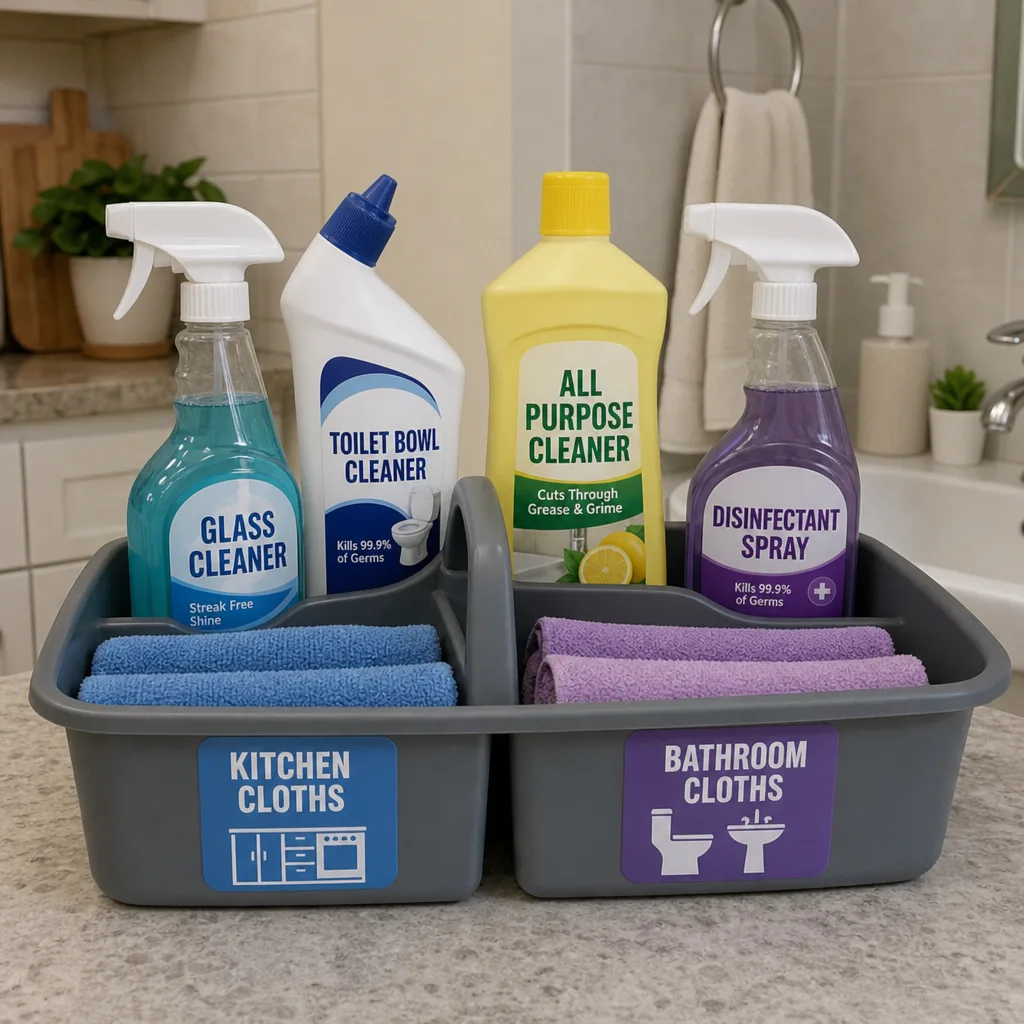
You do not need a cupboard full of specialist bottles to begin. Start with the surfaces you own, check their care instructions and choose products intended for those materials. Keep the kit manageable enough that gathering supplies does not become a separate job.
A practical starting kit might include:
A general-purpose cleaner suitable for your everyday washable surfaces.
Washing-up liquid for dishes and other uses permitted by its label.
A bathroom product appropriate for your fixtures and finishes.
A floor cleaner approved for your particular flooring.
Several washable cloths, with separate ones for kitchen and bathroom work.
A toilet brush, suitable scrubbing brush, vacuum cleaner and mop.
Any protective equipment specified on product labels.
Treat this as an inventory to check, not a shopping list to complete immediately. You may already have everything needed for your first week. Add a specialist product only when a particular surface or task genuinely requires one.
Product labels take priority over online shortcuts. Follow directions for use, dilution and protective equipment, and never mix cleaning products. Keep containers closed and retain clear labelling rather than transferring products into unmarked bottles. (cdc.gov)
For disinfectants, check the stated contact time: the surface must remain visibly wet for the full period specified. A quick spray followed by immediate wiping may not meet the product’s directions. Check any rinsing requirements as well, particularly where food is prepared. (epa.gov)
Store your supplies securely, out of reach of children and pets. Once the work is finished, put the kit away rather than leaving bottles beside the area you have cleaned. (cdc.gov)

Build a daily reset around existing habits
A daily reset is a short round of essential tasks, not a miniature deep clean. Choose actions that leave your home ready for its next use: a usable kitchen for breakfast, a clear bathroom basin and somewhere to sit without moving a pile of belongings.
Attach these actions to moments that already exist in your day. You might unload the dishwasher while the kettle boils, clear the table after dinner or return bathroom products after getting ready. Choose the connection that feels natural rather than introducing several new alarms.
Morning essentials
Keep the morning list brief enough to fit around getting out of the door. Put sleepwear away, place dirty clothes in the laundry basket and leave breakfast dishes washed or ready for the dishwasher. If making the bed matters to you, include it; if not, prioritise something with greater practical value.
Avoid beginning jobs you cannot finish before leaving. Starting a cupboard clear-out or spreading laundry across the bed can create another task for the evening. A successful morning reset should leave fewer loose ends, not more.
Evening essentials
Use the evening reset to prepare the spaces you will need first tomorrow. Focus on the kitchen, shared living area and entrance rather than checking every room. If several people live together, give each person a small, clearly defined contribution.
Your evening home cleaning checklist could be:
Wash dishes or load the dishwasher, then clear the sink.
Clean food preparation surfaces and deal with visible spills.
Put food away and remove rubbish when needed.
Return loose belongings to their usual places.
Clear walking routes and prepare frequently used items for tomorrow.
Stop when the reset is complete. You can note a larger job without beginning it immediately. Keeping that boundary makes the daily routine easier to repeat on an ordinary working evening.
How do you build a weekly house cleaning schedule?
Build a weekly house cleaning schedule by listing the maintenance tasks your home needs, grouping them into manageable sessions and assigning each session a realistic place in your week. Start with one main focus per day, then adjust after trying it. The best schedule is one you can repeat without constantly borrowing time from sleep or rest.
The following example spreads the work across the week. It is a planning template, not a rule about how often every household must clean.
Day Main focus Suggested scope Monday Bathrooms Clean the basin, bath or shower, toilet, mirror and floor. Tuesday Dusting Work around accessible shelves, furniture and other surfaces. Wednesday Bedrooms and linen Change bedding as needed, tidy bedside areas and complete the laundry. Thursday Floors Vacuum carpets and clean hard floors using their recommended method. Friday Kitchen maintenance Clean the hob, appliance exteriors, handles and other frequently used areas. Saturday One rotating task Choose a cupboard, overlooked corner or appliance care task. Sunday Review and reset Put supplies away, check the coming week and move any unfinished priority job.
Keep everyday essentials running alongside this schedule. A kitchen maintenance session on Friday does not mean leaving spills until then. Likewise, clean an obviously dirty bathroom surface when it needs attention rather than waiting for Monday.
If daily sessions do not suit you, combine the same jobs into two larger blocks. For instance, pair bathrooms with floors, then group dusting with bedrooms and linen. Keep the total workload visible so neither session becomes an open-ended catch-up.
When a day is missed, move the most important unfinished task into the next available slot. Do not automatically double tomorrow’s list. A schedule should help you recover from interruptions, not turn one missed session into a week of backlog.
Leave some breathing room, especially at the weekend. If every available slot already contains work, there is nowhere for an unexpected spill, a late meeting or a much-needed break to go.
Use a room-by-room house cleaning checklist
Your weekly schedule tells you when to clean; a room-by-room checklist tells you what to do. Keep the wording specific and place the list somewhere accessible. You should be able to begin without reconstructing the whole job in your head.
The lists below are suggested maintenance scopes. Adjust them for your fixtures, surface instructions and how often the room is used. Do not add every possible detail to every weekly session.
Kitchen
Begin by putting food away and dealing with dishes so the worktops are accessible. Then follow a defined route rather than moving between unrelated jobs. Leave detailed cupboard sorting for another session.
Clear the worktops and dining surface.
Clean worktops using a suitable product.
Clean the hob when cool and according to its care instructions.
Wipe accessible appliance exteriors and frequently used handles.
Check the microwave and fridge for visible spills.
Clean the sink and surrounding area.
Empty the bin when needed and clean visible marks around it.
Finish with the floor.
Treat food contamination separately from ordinary tidying. Surfaces contaminated by raw meat, poultry or their juices need cleaning followed by appropriate sanitising, following the product directions. Do not rely on a general weekly wipe-down for that job. (cdc.gov)
Bathroom
Give yourself room to work by putting personal items away first. Gather the tools needed for this room so you do not have to borrow a kitchen cloth halfway through. Finish the session by returning products and replacing anything you have moved.
Clear toiletries from the area being cleaned.
Clean the mirror, basin and taps with suitable products.
Clean the bath or shower, including accessible edges.
Clean the toilet using dedicated tools.
Wipe appropriate frequently touched surfaces.
Replace towels and bathmats when needed.
Empty the bin and clean the floor.
Check the room while you work rather than treating every mark as ordinary dirt. A persistent leak or recurring damp patch belongs on a maintenance list, not just the next cleaning checklist. Record what you have noticed so it is not forgotten once the room looks tidier.
Bedrooms and living areas
Separate putting belongings away from dusting and floor care. If you have only a short session, clear the surfaces you intend to clean rather than emptying every drawer. Keep a separate note of storage problems that deserve attention later.
Return clothes, books, toys and other belongings to their places.
Change bedding when required and take removed linen to the laundry area.
Dust accessible furniture and shelving.
Check bedside tables, coffee tables and other frequently used surfaces.
Empty wastepaper bins.
Vacuum accessible floor areas and suitable upholstered furniture.
Return moved items once the cleaning is complete.
Follow the manufacturer’s care instructions for electronics rather than treating them like ordinary furniture. Screens, keyboards and remote controls may need different methods, so keep them as separate checklist items if necessary. (cdc.gov)
Entrance and utility spaces
Give these areas a modest but explicit place on your list. Otherwise, they can become the destination for everything removed from other rooms. Your aim is a usable entrance and a laundry area where the next job can begin.
Put shoes, bags and coats in their designated places.
Clear the area immediately inside the door.
Check mats and surrounding flooring for dirt.
Put laundry products away after use.
Return clean laundry baskets to their storage spot.
Note appliance care tasks separately, following the relevant manual.
Clean in an order that avoids repeating work
For a general cleaning session, clear clutter first, work from higher surfaces towards lower ones and leave floors until last. This gives the session a consistent route and avoids vacuuming before dusting above the same area. The American Cleaning Institute recommends this systematic approach rather than moving haphazardly between tasks. (cleaninginstitute.org)
Use one direction around the room, starting at the doorway or another obvious point. Finish each accessible surface before moving onwards. If you notice a different job, write it down rather than abandoning the route.
A straightforward sequence is:
Prepare: gather supplies and remove items obstructing the work.
Clean higher areas: tackle accessible shelves and furniture tops within the session’s scope.
Work downwards: clean the remaining surfaces and fixtures.
Finish the floor: move towards the exit rather than walking back across the cleaned area.
Close the job: return belongings, put tools away and record any maintenance issue.
Keep the session’s purpose clear. “Clean the living room” should not quietly become “sort every photograph in the sideboard”. Put that project on the rotating list and carry on with the room.
Distinguish routine cleaning from disinfecting, too. Cleaning removes dirt and impurities; disinfecting is an additional process. CDC guidance says regular cleaning is generally sufficient in most household situations, with additional disinfection relevant when someone is ill or has a weakened immune system. (cdc.gov)
Borrow useful ideas from the FlyLady cleaning routine
The FlyLady cleaning routine offers an alternative to treating the whole home as one enormous job. Its zone approach focuses on a particular area, using short sessions rather than an unrestricted cleaning marathon. FlyLady recommends spending 15 minutes a day on the current zone and prioritising decluttering first when belongings obstruct detailed cleaning. (flylady.net)
You can borrow that principle without adopting every part of the system. Keep daily essentials and weekly maintenance in place, then choose one area for extra attention. That might be the entrance one week and a bedroom storage area another.
Make the task smaller than the room. Instead of writing “deep-clean bedroom”, choose “clear the bedside drawer” or “clean the accessible skirting board behind the chair”. A narrow task gives your short session an obvious beginning and end.
For your own adapted version, set a timer that suits your energy and commitments. When it ends, finish safely, put tools away and note the next step. The timer is a boundary for your effort, not a promise that the room will be finished within it.
If decluttering brings up difficult decisions, separate those from straightforward cleaning. You can clean an accessible shelf today and decide what to keep on it another time. Progress does not require resolving every storage problem first.
Adapt the checklist for Salt Lake City homes
A routine home cleaning checklist for Salt Lake City can follow the same daily and weekly structure, with extra thought given to indoor dust and local air conditions. Salt Lake City’s sustainability guidance highlights both summer wildfire smoke and winter inversions as reasons to pay attention to indoor air quality. It also recommends regular surface and floor cleaning to help address indoor particles. (slc.gov)
Rather than adding a long separate schedule, include a few relevant checks in your existing plan:
At the entrance: check mats, shoe storage and the floor where outdoor dirt arrives.
During dusting: include frequently used surfaces rather than waiting for a whole-house deep clean.
On floor day: use methods suitable for the flooring and follow vacuum maintenance instructions.
During the weekly review: note filter checks and other air-system maintenance required by the equipment manual.
For particle control, the city recommends HEPA filtration when vacuuming and wet cleaning methods for appropriate surfaces. Use those recommendations alongside the care requirements of your own flooring and furnishings. They are not a reason to soak materials that require a different cleaning method. (slc.gov)
Keep housekeeping and air-quality decisions distinct. A tidy room is not evidence that the air is clean, and cleaning alone is not a complete response to outdoor pollution. Use the local guidance to inform a broader household plan rather than expecting extra dusting to solve every concern. (slc.gov)

How long should your cleaning sessions take?
Your cleaning sessions should take the time needed for the agreed tasks within a realistic limit, rather than matching a universal whole-house estimate. Home size, clutter, surface care and the scope of the job all affect what you can complete. Measure your own routine before deciding how much time to reserve.
During your first week, record how long each main task takes. Separate preparation, cleaning and putting things away so you can see what the session actually involves. If bathroom cleaning regularly overruns because you also sort toiletries, move that sorting task elsewhere.
Use those observations to resize the plan. You might split the bathroom across two sessions, clean floors by area or move linen changes away from your busiest morning. Give yourself a defined stopping point instead of leaving every session open-ended.
For clarity, the question “how long does a routine dental cleaning take?” concerns a different service altogether. The Washington Dental Hygienists’ Association says an adult routine cleaning appointment is commonly allotted 45 minutes to an hour, with individual circumstances affecting the time needed. Confirm the expected appointment length with your dental practice rather than using a household cleaning estimate. (wsdha.org)
For housework, compare your progress with your own starting point. The useful measure is whether essential tasks are getting done within the time you can reasonably give them.
Share responsibility and keep a reduced version ready
A shared routine needs ownership, not occasional offers to help. Assign complete tasks, including preparation and putting things away, so one person does not remain responsible for managing everyone else. Write down the agreed scope wherever the schedule lives.
For example, ownership of laundry might include checking baskets, washing, drying, folding and returning clothes. If that is too much for one person, divide the stages explicitly. Avoid leaving the handover to an assumption that someone else will notice.
Give everyone access to the checklist and agree how unfinished work will be flagged. A quick message or tick-box is enough; the system does not need constant supervision. Review the arrangement when work patterns, mobility or other responsibilities change.
Prepare a reduced routine before you need it. On a demanding day, you might choose only these essentials:
Deal with food, dishes and the space needed for the next meal.
Clean immediate spills and visibly dirty essential fixtures.
Keep walking routes and exits clear.
Put rubbish in the appropriate bin and remove it when needed.
Leave tomorrow’s most important space ready to use.
Optional polishing and organisation can wait. When normal capacity returns, resume the next priority rather than attempting to repay every missed task. A sustainable routine includes a way through difficult weeks.
Review the routine and keep what works
After trying your plan for a couple of weeks, look at what was repeatedly missed and what felt unnecessary. An unfinished task may need a smaller scope, a different day or clearer ownership. Treat that information as a reason to adjust the plan, not criticise yourself.
Keep the cleaning tips that make everyday life easier and remove rules that add work without serving your household. Your routine is doing its job when essential spaces stay usable and you know what to tackle next. Start small, repeat the useful parts and let the schedule change with your home.
Lucy & Phil Property Solutions
Professional facilities management, commercial cleaning, property maintenance, and construction support across the UK.