
Efficient House Clearance Solutions by Lucy & Phil
Lucy & Phil lists waste and property clearance among its property services, making the business a point of enquiry when you need unwanted items removed. This guide explains how to plan household waste clearance, prepare gardens and garages, and agree a clear collection brief. Start with what needs to go, protect what matters, and confirm the details before booking. (checkatrade.com)
What should a house clearance service include?
A house clearance service should have an agreed scope covering the items to be removed, their location, access arrangements and the work included in the quotation. Before booking, ask whether the proposed service covers collection only or also includes lifting, dismantling and clearing items from individual rooms. Treat anything not confirmed in writing as something to clarify, rather than an assumed extra.
Describe the result you want. Removing a broken wardrobe is a different brief from emptying bedrooms, clearing cupboards and preparing a property for its next occupant. If you need cleaning afterwards, discuss that separately so that “clearance” and “ready to use” mean the same thing to everyone involved.
A useful enquiry should explain:
The spaces involved: name each room, outbuilding or outdoor area rather than saying “the whole property”.
The main items: list bulky furniture, appliances, bagged rubbish and anything requiring individual assessment.
What must remain: identify fitted items, retained furniture and belongings awaiting a family decision.
Your deadline: mention moving arrangements or handover dates, while allowing the provider to confirm availability.
For home clearance services, this written brief gives you a practical basis for comparing quotations and checking the finished work.
Start with decisions, not bin bags
Before arranging household rubbish clearance, walk through the property and separate decisions from physical work. Decide what you want to keep before asking anyone to remove things. Use labelled areas or a simple room-by-room list if there is not enough space to sort everything into piles.
Try four categories: keep, offer for reuse, remove, and review. The review category is particularly useful for photographs, paperwork, inherited possessions and items belonging to someone else. Give yourself permission to pause over those belongings without delaying decisions about obvious rubbish.
For belongings you no longer need but that remain usable, consider selling or giving them away before booking disposal. GOV.UK includes these options alongside council collections, recycling centres and registered private waste services. Check that a recipient or organisation actually wants an item before setting it aside for collection. (gov.uk)
Keep passports, financial documents, keys and personal devices outside the clearance area. If several people are involved, nominate one person to approve removals and handle queries. For a sensitive family clearance, agree which rooms or boxes need a final check before anything leaves.
Give garden clearance its own brief
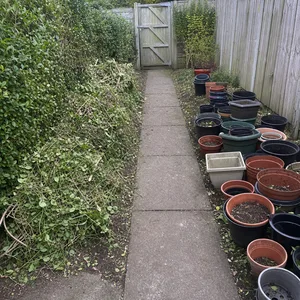
When requesting garden waste clearance, describe the materials rather than calling everything “garden rubbish”. List cuttings, branches, old pots, outdoor furniture and any other unwanted items separately. Ask which materials the provider accepts and whether any need a separate quotation or collection arrangement.
Be equally clear about the work itself. If branches are already cut and stacked, say so; if you want vegetation cut back, explain that this is part of your enquiry. Do not assume garden clearance services include gardening, tree work, shed dismantling or removal of fixed structures.
For garden rubbish clearance, take photographs showing both the pile and its surroundings. Include the gate, side passage, steps and the route to a possible loading point. Explain whether access crosses a lawn or passes through the house, and ask how the route should be prepared.

Decide what you want the cleared space to become. Perhaps you need room for seating, access to a shed, or a manageable starting point for a planting project. Share that aim, but keep any landscaping work separate from the removal brief unless it is expressly included.
Approach garage clearance in stages
For garage clearance services, begin by identifying what is actually stored inside. Work from the accessible entrance towards the back, recording visible items without climbing over unstable piles. Photograph areas you cannot assess easily and explain those limitations when enquiring.
Before choosing a garage clearance company, ask how it handles mixed contents and which items need separate assessment. Declare paint, oils, batteries, electrical equipment and unidentified containers rather than hiding them within general rubbish. Leave containers closed and let the provider explain what information is needed.
If you suspect asbestos in roofing, panels or stored building materials, stop and seek specialist advice rather than disturbing it. UK Health Security Agency guidance advises against DIY asbestos removal without advice and directs householders to their local council for disposal information. Treat this as a separate issue, not part of an ordinary garage tidy-up. (gov.uk)
Set aside tools and seasonal equipment you intend to keep before removal begins. Once the agreed items are gone, check the space before buying storage. Plan shelving around the belongings that remain, not around the clutter you have just removed.
How do you choose a suitable clearance provider?
Choose a clearance provider by checking that it can handle your particular items, reach the collection point, explain its quotation and demonstrate the appropriate waste-carrier registration. Location alone is not enough. Ask direct questions and compare written scopes rather than relying on a headline price.
If you are searching for “garden waste clearance near me”, use the results as a shortlist, not a final decision. Confirm coverage for your address, describe the access and check whether the company accepts your particular mixture of materials. A nearby provider still needs the details of the job.
In England, GOV.UK says householders using a private waste collection business must check that it appears on the waste-carrier register, selecting upper-tier registration. There are separate registration checks for Wales, Scotland and Northern Ireland. Ask for the registration details and verify them through the relevant official register rather than relying on an advert. (gov.uk)
For house rubbish clearance, also ask what happens after collection. Request a clear explanation of the intended disposal arrangements and what collection documentation you will receive. Avoid treating a broad environmental claim as a substitute for specific answers about your waste.
Prepare for a clear, comparable quotation
Give each provider the same information so you can compare the proposed work fairly. Send an overview photograph of each area, closer images of unusual items and a written list of anything not visible. Mention stairs, narrow doorways, parking restrictions and any distance between the property and the loading point.
Use this checklist before accepting a quotation:
Confirm the inventory. Check that all agreed rooms, piles and bulky items appear in the description.
Clarify labour. Ask whether lifting, dismantling and carrying from the stated locations are included.
Identify exclusions. Record items or materials that cannot be collected under the proposed booking.
Agree the price basis. Ask what could change the charge and how any change would be approved.
Define completion. Establish whether the work ends at removal or includes any sweeping or cleaning.
Check practical arrangements. Confirm access, attendance requirements and who to contact if plans change.
If the amount of waste changes after the quotation, send updated photographs before collection day. Ask for confirmation of any revised scope or charge rather than leaving the difference to be discussed once work starts.
Keep collection day straightforward
Before the appointment, clearly mark retained belongings and keep them away from removal areas wherever possible. Make sure the agreed access route is available, without attempting to shift heavy or awkward items yourself. Arrange for children and pets to stay away from the working area.
At the start, walk through the brief with the team and point out anything that could be misunderstood. Identify closed cupboards, shared belongings and items awaiting approval. If something unexpected appears, pause that part of the job and agree the next step.
Before completion, check each agreed area against your list. Resolve any uncertainty while everyone is still present, and retain the quotation, messages and collection paperwork together for reference.
Plan your next step with Lucy & Phil
For house and garden clearance services, approach Lucy & Phil with a concise description of the property, the unwanted items and your preferred timing. Include photographs and access details, then ask the business to confirm coverage, accepted materials, availability and a written quotation.
A well-planned clearance starts with informed decisions, not simply a larger rubbish pile. Keep valued possessions separate, check the provider’s suitability and agree exactly what completion looks like. That gives your enquiry a clear purpose and your clearance a manageable starting point.
Lucy & Phil Property Solutions
Professional facilities management, commercial cleaning, property maintenance, and construction support across the UK.